
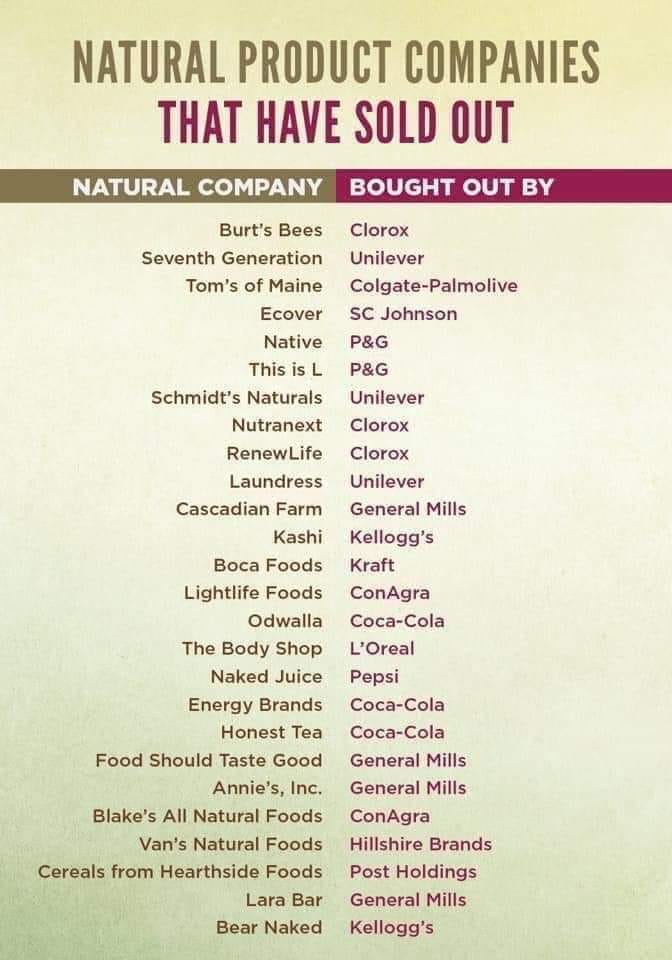
Know who you’re really buying from. Do you think that company really cares about you and your health?
Get the facts.
I plan to publish more about this story, but for now, here’s an infographic that gives the “short version…”
[mepr-show if=”loggedout”]
Please Log In to Read the Rest…
Click here to create an account in order to read the rest of this article…
[/mepr-show][mepr-show if=”loggedin”]
Here’s why this is a problem.
1) It’s sneaky advertising.
When I buy a product that espouses certain values, I expect all of my dollars to go to a company that holds those values—not to contribute to a business behemoth focused on the bottom line. I find it disingenuous that nowhere on the products themselves do these 12 brands identify their corporate ownership; it’s up to the consumer to find the information on their websites, usually buried in a small-font FAQ section.
Worse still, many of the corporations owning these natural brands actively lobby for policies that are decidedly anti-nature. For instance, PepsiCo, Coca-Cola and Kellogg’s are among the companies that donated millions in 2012 against efforts in California to label genetically modified organisms (GMO).
2) Corporations may not uphold the original standards of natural brands.
The non-profit research group Cornucopia Institute has called out several brands for cutting corners after they were acquired by corporations. The Institute reported on GMO grains and pesticide residues in Kashi cereal; the chemical carageenan in Tom’s of Maine toothpaste; and inorganic manufacturing processes in Silk soymilk, among others.
Other brands have quietly changed their products’ formulas, presumably to reduce costs. For instance, many consumers of Cascadian Farm’s Purely O’s were livid when the cereal’s sugar content was tripled and corn was added, without any notice.
And still others have made some questionable expansion choices. Under Coca-Cola’s watch, Honest Tea has developed a Keurig K-Cup version of its product, which uses unrecyclable and excessive plastic packaging. It’s great that Keurig now has an organic, fair trade tea option, but it this really a decision that the 100% independent Honest Tea Company would have made? I have to wonder.
3) The term “natural” continues to lose meaning.
Unlike “organic,” which has a legal definition under the Organic Foods Production Act of 1990, “natural” has no real meaning. It’s generally used for products not containing artificial ingredients, but is says nothing about whether these ingredients are GMO or were produced using artificial inputs, like synthetic pesticides. So it’s easily manipulated to trick consumers.
And companies know this. General Mills is a particular offender: it took a lawsuit for the company to remove the “natural” label from products containing artificial ingredients.
That doesn’t mean that small brands are necessarily more honest; anyone can abuse the “natural” label. But many natural foods companies are founded by concerned consumers precisely because information about products is so hard to get from corporations.
What’s the solution?
Let me recommend my favorite privately held company that produces ONLY safe and natural products. Get the facts and get a $100 incentive to get you started right. Click here for an “online” virtual tour of how to get these safe, effective, and affordable products from a company you can trust. (This redirects you to my other site, DrivingProsperity.com while this site being enhanced.)
[/mepr-show]


